The Role Tech Companies Keep Cutting And Then Regretting
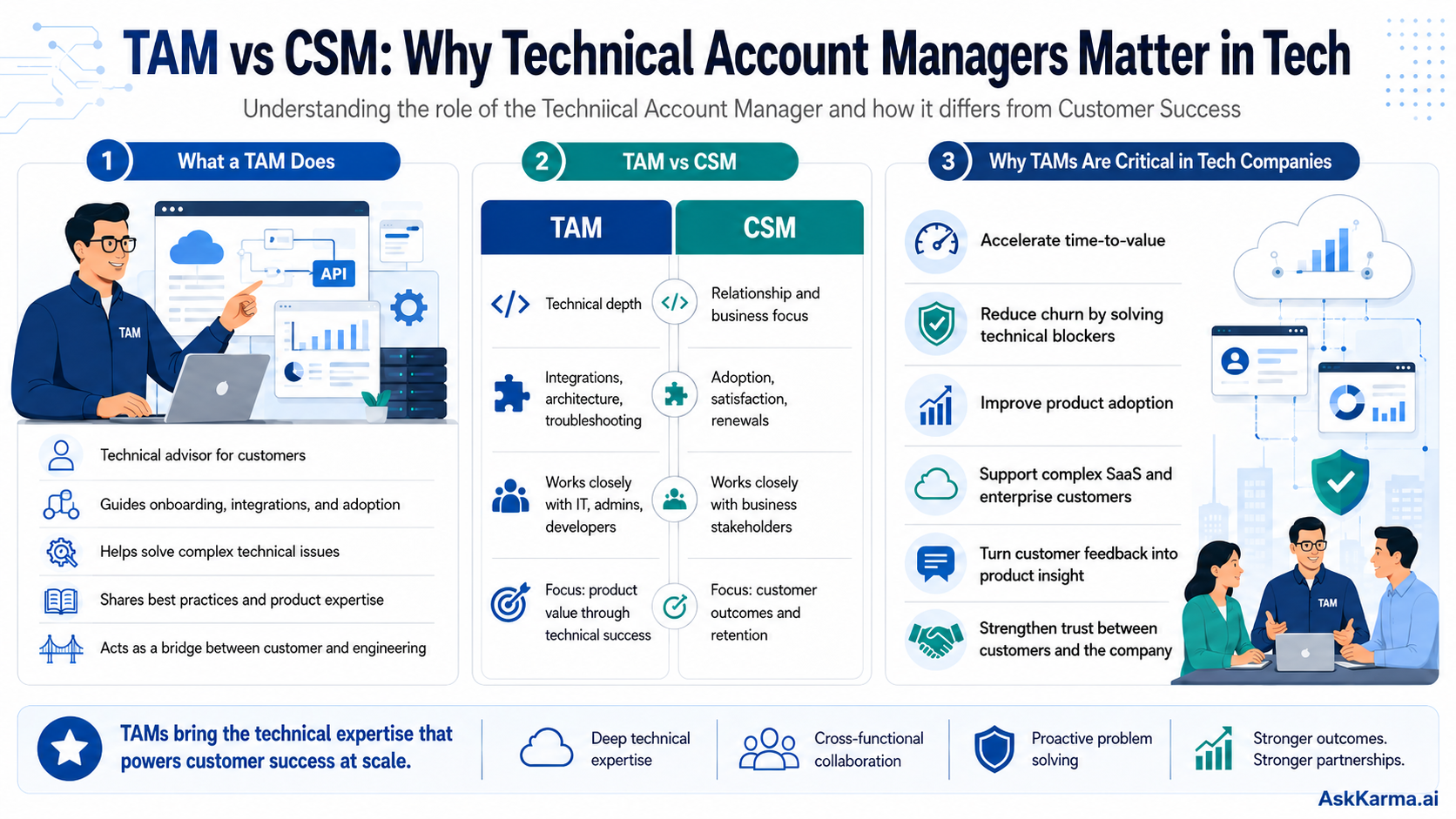
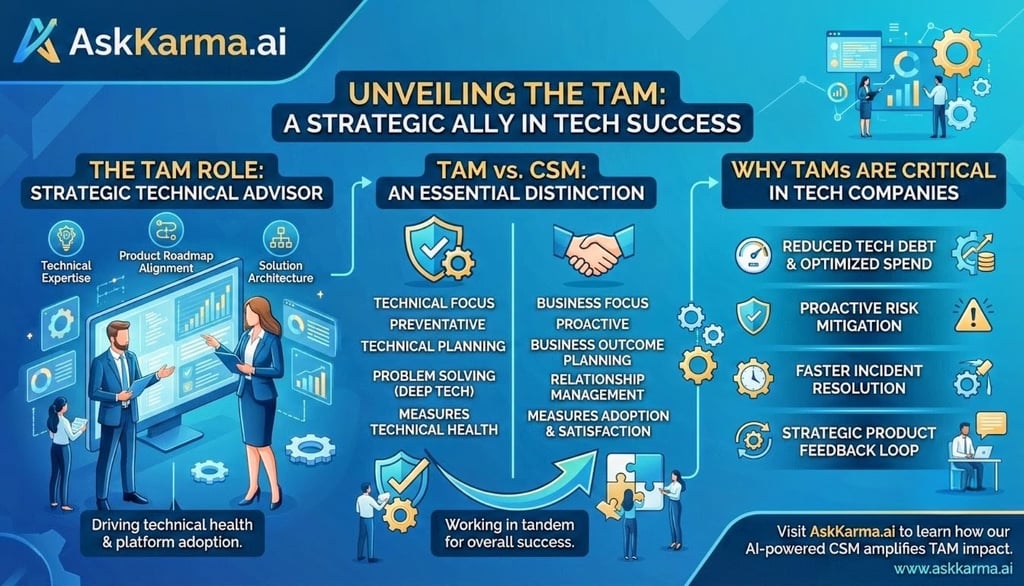
A CSM manages the relationship. A TAM manages the risk. They are not the same so it's time we discuss the differences, and the value.
7/1/20266 min read
The Role Tech Companies Keep Cutting And Then Regretting
Every tech company loves its CSM. The Customer Success Manager is the friendly face on the quarterly call, the person who remembers your kid's name and sends the birthday Slack GIF. Good CSMs matter. They keep the relationship warm and the renewal on track. But somewhere along the way, a lot of companies started treating the CSM as a substitute for a Technical Account Manager instead of a complement to one. That's where things start to crack.
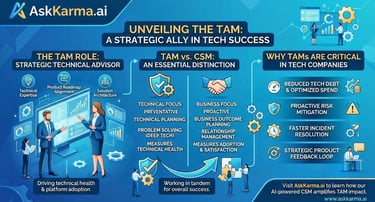
A CSM manages the relationship. A TAM manages the risk.
That's the whole difference in one line, and it's worth sitting with for a second, because it explains everything else. A CSM asks how you're feeling about the product. A TAM knows why your integration broke at 2am, can read your architecture diagram without a translator, and has already flagged the vulnerability in your stack before your security team even opened the CVE alert. One is relationship management. The other is technical stewardship with a business brain attached. You need both. Most companies only budget for one, and they usually pick the cheaper one.
Here's where it gets expensive.
When the inquiry isn't simple
Customer inquiries used to mean billing questions and feature requests. Now they mean "can you confirm your product meets our CMMC Level 2 requirements" or "walk us through your SOC 2 controls before our audit next month." A CSM can escalate that email. A TAM can answer it, because they've lived inside the compliance framework alongside the client, not just sold against it. When a GRC consultant or an auditor asks a pointed technical question and the answer comes back a week later filtered through three people, that delay reads as a red flag. In an audit, delay is data. It tells the assessor something about how seriously the vendor takes its own controls.
I've sat across from CMMC assessors. They don't care about your company culture deck. They want evidence, timestamps, and someone who can speak fluently about how detection, remediation, and documentation actually connect. That's TAM territory. A CSM without technical depth in that room isn't a bridge, it's a bottleneck.
Upselling without a technical translator is just guessing
Sales teams love a TAM more than they let on. A good TAM sits close enough to the client's environment to know where the actual gaps are, not the gaps sales assumes exist because a competitor's marketing page said so. That's the difference between an upsell that lands and one that gets laughed out of a renewal call. When a TAM tells sales "this client's ingestion volume is about to blow past their current tier, here's the real number," that's a conversation grounded in truth. When sales guesses based on a CSM's secondhand notes, it's a coin flip, and clients can tell the difference immediately.
What happens when companies skip it
Look at what's happened across tech in 2026. Fifty tech companies have announced layoffs this year, cutting a combined 167,378 jobs, and a huge share of that has landed squarely on customer support and success roles, as AI chatbots and agents get pushed into tier one and tier two work. Companies are betting that AI can absorb the relationship layer. Maybe it can, for the easy stuff. But nobody's built an AI that can sit in front of an auditor and defend a control gap with credibility, or catch the security implication buried in a client's architecture change before it becomes an incident. That still takes a human who understands both the technology and the business consequences of getting it wrong.
The companies cutting TAM-equivalent roles to protect margin are making a bet that shows up later, in a support ticket that spirals into a churn risk, in an audit finding that could've been caught in week one instead of week twelve, in a renewal that dies because nobody translated the client's real technical need into a sales opportunity. It's a quiet cost. It doesn't show up on the layoff tracker. It shows up eighteen months later in the churn numbers, and by then leadership is asking why retention dropped and nobody connects it back to the technical account function they eliminated to hit a quarterly target.
About the salary line
Yes, TAMs cost more than CSMs. That's not a mistake in the budget, that's the point. You're paying for someone who can read a SIEM alert, speak GRC fluently, and hold their own in a room with a CISO or an auditor, all while still being able to explain any of it to a non-technical stakeholder without condescending to them. That's a rare combination, and rare combinations cost money. The justification isn't sentimental. It's math. One retained enterprise client, one audit that passes clean on the first pass, one upsell that actually closes because someone understood the client's real infrastructure need, and the TAM has paid for themselves several times over. The cost of not having one just doesn't show up on the same line item. It shows up in churn, in failed audits, and in deals that quietly die in the pipeline because nobody could answer the technical question that actually mattered.
What a TAM shouldn't be doing
None of this makes the TAM some kind of do-everything hero, and companies that try to load them up that way end up burning them out or watering down the technical depth that made the role worth the salary in the first place. There's a real line, and it's worth drawing clearly.
Renewal paperwork, contract redlines, and the actual commercial negotiation still belong to sales or a CSM with commercial ownership. A TAM can tell you the technical reason a renewal is at risk. They shouldn't be the one chasing a signature or negotiating price.
Relationship cadence, the regular check-ins, the QBR scheduling, the "just checking in on how things are going" touchpoints, that's CSM territory. A TAM parachuting in for every technical fire looks very different from someone managing the emotional temperature of an account week to week. Mixing the two waters down both.
General product training and onboarding for non-technical users belongs with CSM or a dedicated onboarding team. A TAM should get pulled in when onboarding hits a technical wall, not to walk a marketing team through a dashboard tour.
Billing disputes, invoice questions, and account admin issues are support or finance conversations. A TAM answering "why was I charged twice" is a TAM whose time just got wasted on something that has nothing to do with their expertise.
Sales prospecting and cold outreach to net-new logos isn't TAM work either. TAMs advise sales on upsell and expansion within existing accounts because they understand the environment already in place. Hunting new business is a different skill set and a different incentive structure entirely.
And broad company-wide GRC ownership, building the compliance program itself, isn't on the TAM either. A TAM supports a specific client's audit questions and technical evidence within their book of business. The actual GRC function, policy ownership, and org-wide compliance strategy sits with a GRC consultant or an internal compliance team. A TAM feeds that process. They don't run it.
Get this boundary wrong and you end up with a TAM who's stretched across CSM duties, sales duties, and support tickets, and the technical depth you hired them for gets buried under a stack of tasks that never needed that level of expertise to begin with. That's the fastest way to make an expensive hire feel like a waste of budget, and it's usually a scoping problem, not a people problem.
So what do you do
If you're a tech company deciding between a CSM, a TAM, or nothing at all, here's the honest answer. A CSM alone is fine if your product is simple and your clients never touch compliance. A TAM alone works if you're leaner and want one person who can flex between technical depth and relationship management. Nothing at all is a bet you're making on your own product being simple enough, and your clients being forgiving enough, to never need either. Very few companies actually meet that bar, especially in security, infrastructure, or anything touching regulated data.
The strongest setup pairs both. Let the CSM own the relationship cadence and the emotional temperature of the account. Let the TAM own the technical truth, the audit readiness, and the real conversation about where the client's environment is actually headed. Cut the TAM to save money and you're not simplifying the org chart. You're just moving the cost somewhere you can't see it until it's already expensive.